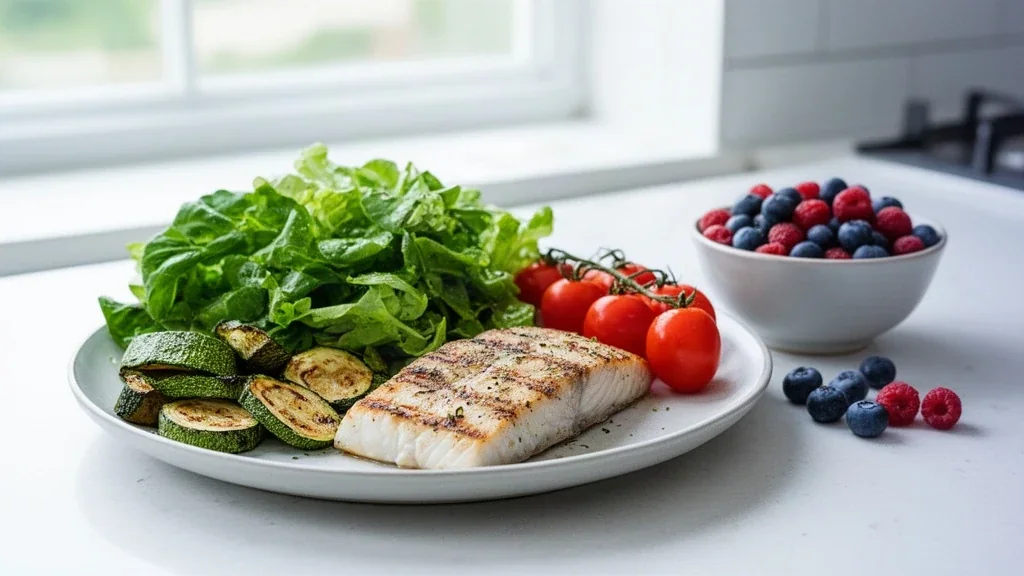
Cutting Macros: How to Set Up a Sustainable Calorie Deficit
A successful fat-loss “cut” has two objective goals: maximize the loss of stored adipose tissue and prevent the loss of skeletal muscle mass.
Crashing your calories by 50% or eliminating carbohydrates will cause rapid scale weight loss, but a substantial portion of that loss will come from muscle protein breakdown, intracellular water, and glycogen depletion. When muscle is lost, your resting metabolic rate declines, hunger signals escalate, and physical strength drops.
To run a cut that preserves lean muscle while shedding body fat, you configure your macronutrients through a systematic four-step formula:
1. Daily Calories  = Maintenance TDEE × (0.75 to 0.85)  [15% to 25% Deficit]
2. Protein Floor   = 1.0 to 1.2g per pound of bodyweight (2.2 to 2.6g/kg)
3. Dietary Fat     = 0.3 to 0.4g per pound of bodyweight (20% to 25% of calories)
4. Carbohydrates   = Remaining Calories ÷ 4
Here is the complete scientific framework for determining your targets, pacing your fat loss, and structuring a day of verified cutting meals.
Step 1: Establish Your Real Maintenance Baseline (TDEE)
Before creating an energy deficit, you must establish your Total Daily Energy Expenditure (TDEE)—the number of calories your body burns in 24 hours through Basal Metabolic Rate (BMR), the Thermic Effect of Food (TEF), Non-Exercise Activity Thermogenesis (NEAT), and Exercise Activity Thermogenesis (EAT).
You can estimate baseline maintenance using the Mifflin-St Jeor equation or a standard activity multiplier:
Estimated Maintenance = Bodyweight (lbs) × Activity Factor
- Sedentary (Desk job, minimal daily movement): Bodyweight × 13 – 14
- Moderately Active (3–4 resistance sessions + 7k–9k daily steps): Bodyweight × 14 – 15
- Very Active (5+ intense training sessions + 10k+ daily steps): Bodyweight × 15 – 16
Example: A 200-pound moderately active lifter typically maintains weight around 200 × 15 = 3,000 kcal/day.
Step 2: Choose Your Deficit Rate (15% to 25%)
Core Nutrition Planning & Macro Balance Protocol
- Calculate daily energy expenditure using Mifflin-St Jeor formulas and adjust for target rate of change.
- Distribute protein evenly across breakfast, lunch, dinner, and snacks for continuous muscle protein synthesis.
- Use digital food scales and airtight meal prep containers to eliminate guesswork in weekly nutrition.
Macro arithmetic verified against USDA FoodData Central and Atwater 4P+4C+9F standard.
The size of your calorie deficit dictates both the rate of fat loss and the risk of muscle loss. Sports nutrition research demonstrates that aggressive deficits impair athletic performance and accelerate muscle loss in trained individuals.
A controlled trial by Garthe et al. (2011) compared two rates of weight loss in competitive athletes:
- Slow Loss Group (0.7% of bodyweight lost per week): Lost significant body fat while increasing lean body mass by 2.1% and improving strength.
- Fast Loss Group (1.4% of bodyweight lost per week): Lost fat faster, but lost lean muscle mass and experienced stunted strength progression.
DEFICIT SELECTION MATRIX
| Starting Condition | Deficit % | Target Loss/Week | Primary Goal |
|---|---|---|---|
| High Body Fat (>22%M / >32%W) | 20%–25% | 1.0% of bodyweight (1.5–2.5 lbs) | Fast fat drop, high retention |
| Moderate Body Fat (14–20%M / 23–30%W) | 15%–20% | 0.7% of bodyweight (1.0–1.5 lbs) | Balanced cut, strength hold |
| Lean Athlete (<12%M / <20%W) | 10%–15% | 0.4%–0.5% bodyweight (0.5–1.0 lbs) | Peak muscle preservation |
For most people, a 20% caloric deficit represents the sweet spot between meaningful weekly fat loss and muscle retention.
Step 3: Anchor Your Protein Floor (1.0 – 1.2g/lb)
During energy balance or a surplus, 0.7 to 0.8g of protein per pound of bodyweight (1.6 to 1.8g/kg) is sufficient to maximize muscle protein synthesis (Morton et al. 2018).
However, during a calorie deficit, protein requirements increase. When glycogen stores are depleted and calories are restricted, the body increases the oxidation of amino acids for fuel. A higher protein intake provides three critical protective mechanisms:
- Muscle Preservation: Directs amino acids to muscle tissue, blunting catabolism (Helms et al. 2014).
- Satiety Enhancement: Protein stimulates the release of satiety hormones (PYY, GLP-1) while suppressing ghrelin, controlling diet-induced hunger.
- Thermic Effect: Approximately 20% to 30% of protein calories are burned during digestion and assimilation, compared to 5% to 10% for carbohydrates and 0% to 3% for dietary fats.
Cutting Protein Recommendation: Set daily protein between 1.0g and 1.2g per pound of total bodyweight (or 1.1g to 1.3g per pound of lean body mass for individuals with higher body fat).
Step 4: Distribute Dietary Fats and Carbohydrates
Once your calorie deficit and protein floor are established, distribute the remaining calories between dietary fats and carbohydrates.
Set the Dietary Fat Minimum (0.3g to 0.4g/lb)
Dietary fat is mandatory for steroid hormone production (testosterone, estrogen), fat-soluble vitamin absorption (vitamins A, D, E, K), and cell membrane health.
- Minimum Floor: 0.3g per pound of bodyweight (or roughly 20% to 25% of total cutting calories).
- Hard Rule: Never drop dietary fats below 15% of daily calories for extended periods to avoid endocrine downregulation (Volek et al. 1997).
Allocate the Remainder to Carbohydrates
Carbohydrates are not stored directly as body fat when total calories are in an overall deficit. Carbohydrates maintain intramuscular glycogen levels, power high-intensity resistance training sessions, and blunt cortisol elevation.
Carbohydrate Grams = Daily Calorie Target - (Protein Grams × 4) - (Fat Grams × 9) / 4
Worked Example A: 200 lb Male Lifter (Cutting from 22% to 14% Body Fat)
- Stats: 200 lbs, 4 resistance workouts weekly + 8,000 daily steps.
- Estimated Maintenance (TDEE): 200 × 15 = 3,000 kcal/day.
- Target Deficit (20%): 3,000 × 0.80 = 2,400 kcal/day (-600 kcal deficit).
1. Protein Target: 200g × 4 kcal/g = 800 kcal (1.0g per lb)
2. Dietary Fat Target: 65g × 9 kcal/g = 585 kcal (~24.4% of calories, 0.325g per lb)
3. Carbohydrate Target: (2,400 - 800 - 585) = 1,015 kcal / 4 kcal/g = 253.75g (rounds to 254g)

Daily Target: 2,400 Calories | 200g Protein | 254g Carbs | 65g Fat
Macronutrient Math Check: (200 × 4) + (254 × 4) + (65 × 9) = 800 + 1,016 + 585 = 2,401 kcal
Worked Example B: 145 lb Female Lifter (Cutting from 26% to 20% Body Fat)
- Stats: 145 lbs, 4 resistance workouts weekly + 7,500 daily steps.
- Estimated Maintenance (TDEE): 145 × 14 = 2,030 kcal/day.
- Target Deficit (20%): 2,030 × 0.80 = 1,625 kcal/day (-405 kcal deficit).
1. Protein Target: 145g × 4 kcal/g = 580 kcal (1.0g per lb)
2. Dietary Fat Target: 45g × 9 kcal/g = 405 kcal (~25% of calories, 0.31g per lb)
3. Carbohydrate Target: (1,625 - 580 - 405) = 640 kcal / 4 kcal/g = 160g

Daily Target: 1,625 Calories | 145g Protein | 160g Carbs | 45g Fat
Macronutrient Math Check: (145 × 4) + (160 × 4) + (45 × 9) = 580 + 640 + 405 = 1,625 kcal
Full Day of Verified Cutting Meals (1,625 kcal / 145P / 160C / 45F)
Here is a practical 4-meal cutting day built with verified whole-food combinations. Every meal satisfies the exact 4P + 4C + 9F = Calories arithmetic:
1. Breakfast: High-Protein Scramble & Toast
- 1 cup (240g) Liquid Egg Whites + 1 Large Whole Egg
- 1 slice Sprouted Whole Grain Bread
- 1 cup Baby Spinach & Sliced Mushrooms (sautéed in cooking spray)
- 1/2 medium Grapefruit
| Macro | Quantity |
|---|---|
| Protein | 34g |
| Carbs | 28g |
| Fats | 6g |
| Calories | 302 kcal |
Math check: (34 × 4) + (28 × 4) + (6 × 9) = 136 + 112 + 54 = 302 kcal.
2. Lunch: Chicken Teriyaki & Steamed Rice Bowl
- 5 oz Grilled Boneless Skinless Chicken Breast
- 3/4 cup Cooked Jasmine Rice
- 1/2 cup Steamed Shelled Edamame
- 1 cup Steamed Broccoli florets + 1 tbsp Low-Sodium Teriyaki Glaze
| Macro | Quantity |
|---|---|
| Protein | 45g |
| Carbs | 46g |
| Fats | 7g |
| Calories | 427 kcal |
Math check: (45 × 4) + (46 × 4) + (7 × 9) = 180 + 184 + 63 = 427 kcal.
3. Mid-Afternoon Snack: Greek Yogurt & Berry Parfait
- 1 cup (227g) Nonfat Plain Greek Yogurt
- 1 cup Fresh Blueberries
- 18g (approx. 15) Whole Raw Almonds
| Macro | Quantity |
|---|---|
| Protein | 25g |
| Carbs | 36g |
| Fats | 10g |
| Calories | 334 kcal |
Math check: (25 × 4) + (36 × 4) + (10 × 9) = 100 + 144 + 90 = 334 kcal.
4. Dinner: Baked Salmon, Roasted Sweet Potato & Asparagus
- 4.5 oz Wild Baked Salmon Fillet
- 200g Baked Sweet Potato (cubed)
- 1.5 cups Roasted Asparagus with 1.5 tsp Extra Virgin Olive Oil
| Macro | Quantity |
|---|---|
| Protein | 41g |
| Carbs | 50g |
| Fats | 22g |
| Calories | 562 kcal |
Math check: (41 × 4) + (50 × 4) + (22 × 9) = 164 + 200 + 198 = 562 kcal.
Daily Macronutrient Summary
| Meal | Protein | Carbs | Fats | Calories |
|---|---|---|---|---|
| Breakfast: Egg White Scramble | 34g | 28g | 6g | 302 |
| Lunch: Teriyaki Chicken Bowl | 45g | 46g | 7g | 427 |
| Snack: Greek Yogurt & Almonds | 25g | 36g | 10g | 334 |
| Dinner: Salmon & Sweet Potato | 41g | 50g | 22g | 562 |
| Total Day | 145g | 160g | 45g | 1,625 |
Macronutrient math check: (145 × 4) + (160 × 4) + (45 × 9) = 580 + 640 + 405 = 1,625 kcal.
How to Handle Weight Stalls During a Cut
Weight loss is never linear. Water retention from cortisol elevation, sodium fluctuations, muscle inflammation from hard training, and digestive contents can mask fat loss on the scale for 2 to 3 weeks.
Before modifying your macros, follow this diagnostic checklist:
WEIGHT STALL DIAGNOSTIC 1. Has the weekly median scale weight stalled for ≥ 21 consecutive days? 2. Are you weighing all cooking oils, dressings, and condiments on a scale? 3. Has your daily step count (NEAT) dropped sub-consciously? 4. Have waist circumference measurements also flatlined?
If you have truly stalled for 3 full weeks and compliance is 100%, your TDEE has adapted downward through reduced body mass and metabolic adaptation.
The Adjustment Protocol
Make modest, controlled reductions rather than dramatic slashes:
- Reduce daily intake by 100 to 150 calories, pulling exclusively from carbohydrates (25g–35g carbs) or non-essential dietary fats (10g–15g fats).
- Never reduce your protein floor. Keep protein anchored at 1.0g/lb to safeguard lean tissue.
- If you have been dieting continuously for over 12 to 16 weeks, consider implementing a structured maintenance phase as outlined in our guide to reverse dieting and diet recovery.
4 Common Cutting Mistakes
1. Eliminating Carbohydrates Completely (Fad Ketosis)
Unless medically indicated or personally preferred for adherence, zero-carb diets compromise training performance. Glycogen depletion reduces work volume and peak power output during lifting sessions, accelerating strength loss.
2. Dropping Dietary Fat Below 15%
Cutting dietary fat down to 10–20g per day leads to lethargy, impaired micronutrient absorption, dry skin, and plummeting circulating sex hormones. Keep fats at or above 0.3g per pound.
3. Relying on Cardio Instead of the Diet
Performing 90 minutes of daily cardio to offset an uncontrolled diet spikes appetite, elevates systemic fatigue, and interferes with resistance training recovery. Create 80% of your deficit through nutrition and 20% through manageable daily movement (e.g., 8,000–10,000 steps).
4. Eyeballing High-Calorie Condiments
Peanut butter, salad dressings, and cooking oils cannot be eyeballed. A “heaping tablespoon” of peanut butter is often 32 grams (190 kcal) instead of the labeled 16 grams (95 kcal). Use a digital gram scale.
Reverse-Engineer Your Cutting Meals
Need meals that fit your specific deficit numbers without manual spreadsheet calculations?
Use our free Macro Meal Planner. Enter your daily calories, protein, carb, and fat targets to instantly discover balanced, verified whole-food meal combinations that hit your cutting targets with precision.
Scientific References
- Aragon A. A., et al. (2017). International Society of Sports Nutrition position stand: diets and body composition. Journal of the International Society of Sports Nutrition, 14(1), 16.
- Barakat C., et al. (2020). Body recomposition: can trained individuals build muscle and lose fat at the same time? Strength and Conditioning Journal, 42(5), 7–20.
- Garthe I., et al. (2011). Effect of two different weight-loss rates on body composition and strength and power-related performance in elite athletes. International Journal of Sport Nutrition and Exercise Metabolism, 21(2), 97–104.
- Helms E. R., et al. (2014). Evidence-based recommendations for natural bodybuilding contest preparation: nutrition and supplementation. Journal of the International Society of Sports Nutrition, 11(1), 20.
- Morton R. W., et al. (2018). A systematic review, meta-analysis and meta-regression of the effect of protein supplementation on resistance training-induced gains in muscle mass and strength in healthy adults. British Journal of Sports Medicine, 52(6), 376–384.
- Volek J. S., et al. (1997). Testosterone and cortisol in relationship to dietary nutrients and resistance exercise. Journal of Applied Physiology, 82(1), 49–54.
- USDA FoodData Central. Nutrient Profiles for Chicken Breast (FDC 171077), Liquid Egg Whites (FDC 172183), Atlantic Salmon (FDC 175167), and Sweet Potatoes (FDC 168482). fdc.nal.usda.gov.
Tools That Make This Easier
A few tools remove the guesswork from the math above:
 Etekcity Smart Nutrition Food Scale — weighs portions when the deficit leaves almost no margin for error.
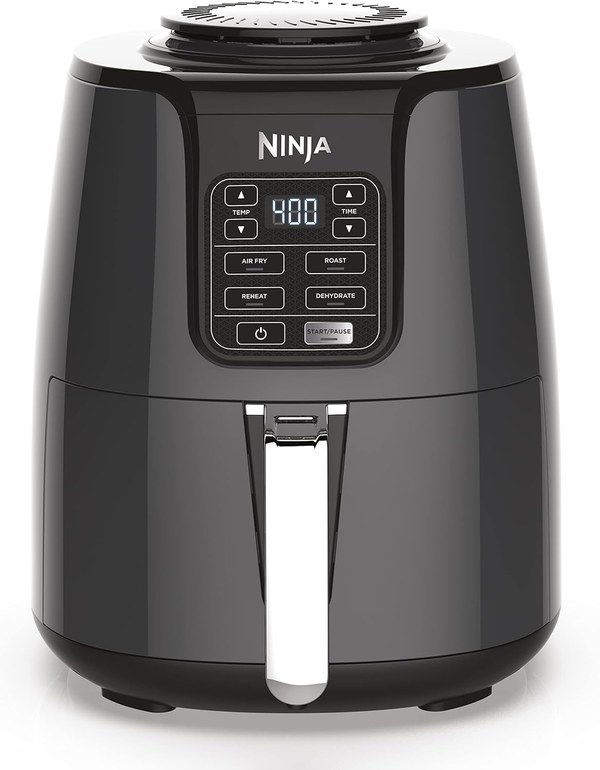 Ninja AF101 Air Fryer (4 Quart) — cooks lean protein without the oil that silently adds fat grams.
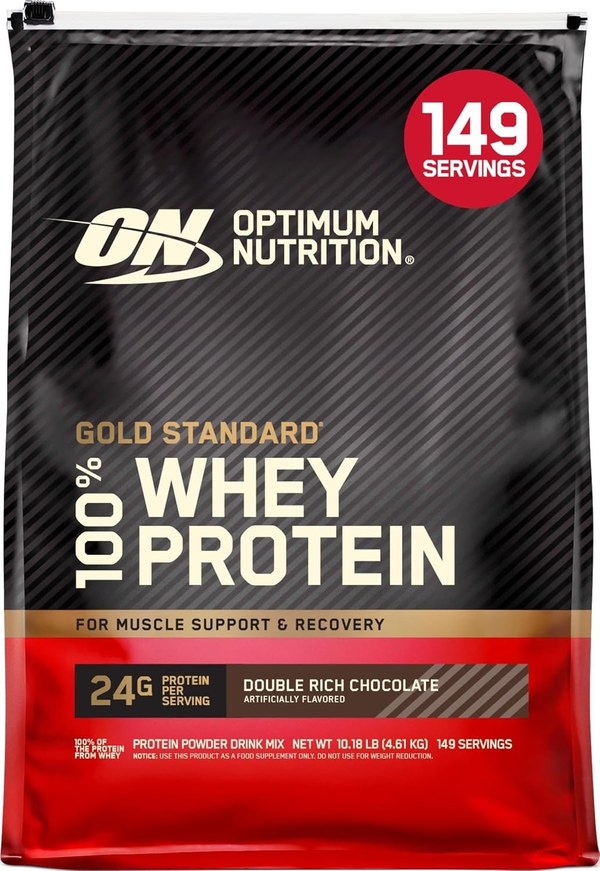 Optimum Nutrition Gold Standard 100% Whey (5 lb) — hits the elevated protein floor of a cut without extra calories.
Disclosure: as an Amazon Associate we earn from qualifying purchases. Prices are current as of writing and may change.